|
F. Herman & St. Smidt
Friedl.Hermann@fbva.bmlf.gv.at
Stefan.Smidt@fbva.bmlf.gv.at
Forest ecosystem research, "new-type forest decline", inneralpine valleys, altitude profiles
F. Herman & St. Smidt: Results from the fields of Integrated Monitoring, bioindicators and indicator values for the characterization of the physiological condition of trees.- Phyton Horn, Austria), ...
As a result of a more profound knowledge, the ways and means of investigating forest damage in Central Europe have markedly changed in recent years. Today we know that there is no cause-effect relationship which can be generally held responsible for such damage and we also know that both the regional and the time-related causes of damages are much more complex than we had originally expected. However, forest damage is frequently the physiological response of the trees to severe disturbances of flux and energy flow.
One of the basic conditions of successful forest conservation is to know how the series of effects which cause changes in the ”normal condition” of trees are inter-connected. We need a screening of telling biochemical-physiological parameters, reflecting the loads on, and the vitality of, ecosystems, to be able to alleviate anthropogenic stress factors before they cause visible damage, and, if required, to provide for socio-economic and forest management measures.
The project ”Studies of Ecosystems in the limestone Alps - Achenkirch Altitude Profiles” is based on the results from the Zillertal studies which have shown the altitudinal dependence of biotic and abiotic stress parameters and outlined the possibility to describe the condition of trees with physiological parameters [bitte anderes Wort], was started in 1990. Research in the limestone Alps proved necessary as the Forest Condition Surveys executed some years before, had shown a substantial thinning of the crowns in the protective forests of the northern limestone Alps in the Tyrol. As for this area, there is little information available about the actual stress caused by long-time effective air pollutants, and as no basic data is available on the metabolism of such systems either, it is necessary to collect basic data so as to be in a position to evaluate potential effects of the current environmental situation on the vegetation.
The altitude profiles established in the research area include autochthonous, nature-conforming, and non-autochthonous mixedwood stands which are to different degrees exposed to the influence of residential districts, to tourism, traffic, and forest pasture management. The way in which these altitude profiles are arranged renders possible the continuous investigation of most different parameters.
The subject-matter project focuses on the following topics:
Apart from the Federal Forest Research Centre, which coordinates the various projects, numerous German and Austrian institutions and/or institutes participate in in the implementation. First results of the project are available. The following contribution offers a summary of the results from the fields of Integrated Monitoring, Bioindicators, and Indicating Values and outline a overview about stress factors depending on the altitude.
The results regarding the ozone concentrations, which were increasing with altitude, showed this pollutant as a potential stress factor not even for the lower elevations, but with great significance for the higher elevations. Ozone indicates an all-year potential risk for sensitive species growing there, esp. European larch. However, this is probably not a danger to the ozone-tolerant Norway spruce.
Seeing the low SO2 und NOx concentrations as individual components and evaluating them on the basis of the relevant threshold levels that are currently applicable, the question whether or not they affect the forest ecosystem can be negated. However, the combined influence of the air pollutants, especially with ozone, and the resulting synergistic effects, are not yet clear; nor is the question whether the stress situation would have to be re-evaluated if additional stress factors were taken into consideration.
The ion concentrations in wet depositions (at the bulk-stations) as well as the proton input were low compared with the results of numerous measuring stations in Austria and showed no distinct altitude dependence; consequently, acid stress cannot be called a cause of forest damage, not even as a result of the area being influenced by carbonado (it is not clear how inputs would change if the occult deposition not investigated so far were also accounted for). Regarding nitrogen input the situation is reversed: nitrogen input in wet depositions alone exceeded the Critical Load for very sensitive sites. We have numerous of sensitive sites in Austria and therefore the discussion about the upper limit is contacted very intensively.
For a more comprehensive description of the investigated area, volatile chlorinated hydrocarbons, pesticides, and trichloroacetic acid were detected in wet depositions and in foliage samples; however, we do not know by now how significant these pollutants are for the injury of forest ecosystems and why they are found in bigger concentrations in needles of certain altitudes; an explenation for this fact might be the height of the inversion layer and therefore an extensive meteorological investigations of the free valley atmosphere took place during the last years.
Heavy metal input, analysed in wet-only-depositions, soil and different bioindicators proved to be greatly increased at higher altitudes so that pollutant inputs can be inferred.
On the basis of the bioindicators tested so far and of our knowledge of air pollution and/or deposition we have obtained on the one hand differing results (sulphur concentrations), on the other corresponding results (heavy metal concentrations) and unsettled questions (volatile halocarbons).
It can also be concluded from the results gained so far that dryness is not a relevant stressor in the research area and that the genetic disposition of the trees has to be taken into consideration when it comes to an evaluation of the condition of trees at higher altitudes.
Altogether, the described results provide further knowledge about:
As a result of more profound knowledge the ways and means of investigating forest damage in Central Europe have markedly changed during in recent years. We know today that there is no general cause-effect relationship to be held responsible for forest damage and that both the regional and the time-related causes of damage are even more complex than had been expected. However, it is certain that forest damage is frequently the physiological response of the trees to severe disturbances of flux and energy flow.
One of the basic conditions of successful forest conservation is to know how the series of effects which cause changes in the "normal condition" of trees are inter-connected. It takes a screening of telling biochemical-physiological parameters, reflecting the loads on, and the vitality of, ecosystems, to be able to alleviate anthropogenic stress factors before they cause visible damage, and, if required, to provide for socio-economic and forest management measures.
The project "Studies of Ecosystems in the Limestone Alps - Achenkirch Altitude Profiles" is based on the results from the research work done in the Zillertal (Federal Forest Research Centre 1992a) and was started in 1990 (Herman 1992a). Research in the limestone Alps proved necessary because of the results of the Austrian Forest Condition Survey carried out in recent years and showing a by far more substantial thinning of crowns in the protective forests of the northern limestone Alps of the Tyrol than had been observed in the provincial average (Office of the Provincial Government of the Tyrol 1989 and 1991a). In the Achenkirch research area Krehan & Tomiczek (1992) classified the thinning of crowns as being slight or medium, although the results are markedly higher than those obtained from the Austrian Forest Condition Survey and the Forest Damage Monitoring System for all-Austria and/or for the entire province of the Tyrol (in 1993 in the Tyrol 44% of the protected forest were damaged; Office of the Provincial Government of the Tyrol 1994). Additional, the results of the Austrian Soil Monitoring System (Mutsch 1992) have shown clearly, that the pollution increased with the exposure (sea level) of the sample plots and can be put down to the fact of long range transport. The results obtained, allow the conclusion that the Alps are a sink of European air pollutants.
The altitude profiles established in the investigation area - extending from the bottom of the valley up to the timberline - differ in respect of site conditions and of the pollution stress. They include autochthonous, nature-conforming, and non-autochthonous mixedwood stands which are to different degrees exposed to the impacts of residential districts, tourism, traffic, and forest pasture management. The arrangement of these altitude profiles renders possible the continuous investigation of most different parameters. As, for the area of the limestone Alps, there is little information available about the actual stress especially caused by long-time effective air pollutants, and as no basic data is available on the metabolism of such systems, either, it is necessary to collect basic data so as to be able to evaluate potential effects of the current environmental situation on the vegetation. The description of the advection of pollutants and the analysis of the meteorological conditions for inneralpine valleys should be rendered possible through the different exposure of the profiles.
The subject-matter project focuses on the following topics:
Apart from the Federal Forest Research Centre, which coordinates the individual projects, numerous Austrian and German institutions and/or institutes have participated in parts of projects (Herman 1993), first results of which are already available (Federal Forest Research Centre 1992b, Herman et al. 1993). The following report offers a summary of the results gained from the fields of integrated monitoring, bioindicators, and indicator values (worked out by the participating groups) as well as an evaluation of their appropriateness for environmental control and for describing the physiological condition of trees.
With the help of integrated monitoring it is possible, in long-term continuous surveys, to find out, on the one hand, about the current state of the ecosystem and the area and about the changes occurring during the observation period, on the other about the flux of elements and the modifications connected therewith. Stress and stress tolerance of the research area are to be described and evaluated by means of applicable limiting values, air quality guidelines, and targets for limiting values.
Climatic stress (measuring year 1993): The degree days decreased with increasing altitude and wee by approx. 60% higher at the valley floor (Talboden) than on the sample plot of the Christlumkopf, which is situated above the timberline. As we had expected, heat stress factors < were observed only during the summer months. During the measuring months with comparable data the light stress index was highest at the uppermost station; the figures calculated for Talboden were remarkably high. Between January and April photochilling events, which also stress the needles, occured at all sites; during the other months no photochilling events were observed on the sample plots of Mühleggerköpfl and Talboden, but a small number of these events were observed on the Christlumkopf between April and October and on the Christlumalm in October (Table 1).
Table 1. Stress indices according to Bolhar-Nordenkampf & Lechner (1989) for the measuring year 1993
Degree day: daily mean values of temperature +2·C - 25·C
multiplied by the number of days.
Heat stress index (HTI): number of half hour means >25·C
multiplied by the respective temperature
High light stress-index (HLI): number of half-hour means of irradiation >
2.5J.cm-2min-1 multipled by the number of half hours of occurrence;
*) without June, projected to the full year
Occurrence of photochilling (PCE): number of half-hour means between -4·C
and +4·C and radiation > 2.5cm-2min-1
|
Mühleggerköpfl |
Talboden |
Christlumalm |
Christlumkopf |
|
| Degree days | 1958 | 2152 | 1744 | 1297 |
| Heat stress index | 130 | 148 | 31 | 0 |
| Photochilling events | 39 | 156 | 91 | 245 |
Precipitation
The evaluation of long-term measuring series showed that, in consequence of precipitation and the draining conditions, desiccation of the soil can be excluded for the entire year. The long-term average of annual precipitation (1961-1990) was 1420mm, with a maximum of 201mm in July and a minimum of 73mm in March. It seems remarkable that, from 1980 onward, annual precipitation was for seven years below the long-term average. Nevertheless no lack of water can be inferred from the calculation of the monthly evapotranspiration. The smaller amounts of precipitation measured in recent years are therefore not to be considered a stressor in the area under investigation (Margl 1994).
Gaseous pollutants
The registrated mean values of the gaseous pollutants NO2 and SO2 must be called low compared to the currently applicable air quality guidelines. Even at the station of Mühleggerköpfl, located 100 meters above the frontier crossing point of Achenwald and heavy with traffic, the monthly averages were low. If we take the ascertained values, any threat to the vegetation by SO2 and NO2 as individual components can be excluded in the research area. Nevertheless an impact on the vegetation through synergistic effects cannot be excluded (Smidt & Gabler 1995; see Krupa & Arndt 1990).
As opposed to SO2 and NOx, the ozone concentrations, especially above the bottom of the valley, frequently exceeded effect-related threshold concentrations of the Austrian Academy of Sciences (1989), and also the recently established preliminary Critical Levels for ozone (UN-ECE 1994) indicate an all-year potential risk for sensitive species growing there, especially the ozone-sensitive European larch (Smidt et al. 1991). According to present knowledge Norway spruce (Picea abies), which is the prevailing tree species in the area under investigation, was to be classified as ”less sensitive” both in respect of foliage damage and with regard to the impact on the photosynthesis (Verein Deutscher Ingenieure 1989; Wieser & Havranek 1993). Larch (Larix decidua), which frequently occurs in the investigation area and which was classified by the Verein Deutscher Ingenieure (1989) as ”sensitive" (in respect of foliage), seemed to be little endangered according to Havranek & Wieser (1993): The photosynthesis activity of a mature larch in the Zillertal (Tyrol, 40km south of the investigation area) was not more affected after the exposure of twigs to ambient air than after the exposure to charcoal-filtered air (Havranek & Wieser 1993). However, in the case of young dwarf pines (Pinus cembra), European beeches (Fagus silvatica) and oaks (Quercus robur), closed-chamber experiments showed negative effects after fumigation with ozone-concentrations between 40 and 100ppb (Krause & Prinz 1989, Guderian et al. 1990, Simons 1993). So, ozone must be taken into account as a pre-disposing factor causing "new-type forest damage" (Ministry of Environment of North Rhine-Westphalia 1993).
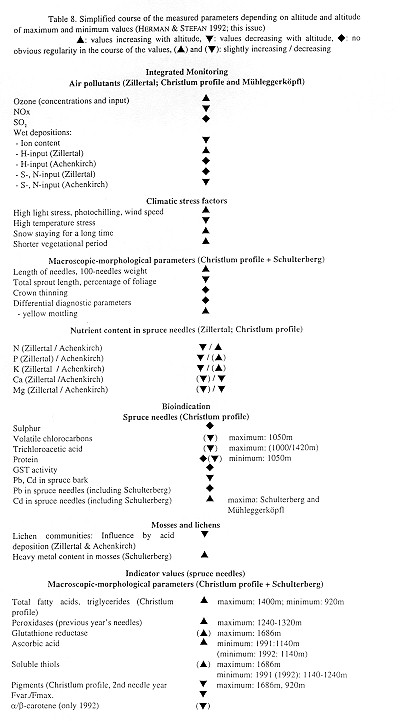
According to the results of previous investigations the climatic stress, the mean concentration of ozone, and the ozone inputs in Alpine valleys rise with altitude (Herman & Stefan 1992), while the mean concentrations of SO2 and NOx decrease with increasing distance from the respective emittor. This was confirmed also for the area of Achenkirch, but as opposed to other Alpine regions, such as the Inn Valley (Office of the Provincial Government of the Tyrol 1991b), the area around the Tauern Highway (Brandtner et al. 1989), and the Loisach Valley (Reiter 1988), the SO2 and NOx concentrations were low already at the bottom of the valley and there was consequently no marked decrease with altitude.
Wet deposition
As compared to other Alpine altitude profiles, the wet deposition measured at the three bulk-measuring points of the Christlumprofil showed low ion concentrations. The annual inputs were low, too. According to Smidt & Mutsch (1993) the inputs (4-year average) into Alpine altitude profiles were as follows:
| 0.05- 0.32 | kg H/ha.a, | |
| 7 - 15 kg | SO4-S/ha.a, and | |
| 7 - 17.5 | kg N/ha.a. |
In Achenkirch (measuring years 1991-1993) the following inputs were measured at the three bulk-measuring points:
| 0.08 - 0.50 | kg H/ha, | |
| 3.6 - 7.7 | kg S/ha, and | |
| 4.8-11.8 | kg N/ha. |
The comparison of the different ranges shows that the H inputs in Achenkirch were in the lower sector, while the sulphur inputs were even lower than the minimum values of the quoted ranges, whereas nitrogen inputs were relatively low.
To extend the basis of comparison, Table 2 gives a general idea of the critical loads for highly sensitive sites, threshold limits for wet deposition in background areas, and the annual Austrian minima of wet deposition.
Table 2. Critical loads for very sensitive sites (quartz and/or feldspar; minerals, granite and quartzite bedrock) and values measured for proton, sulphur and nitrogen inputs (kg/ha.a; deposition measured in the open)
| H | S | N |
| Critical loads for total input and very sensitive sites (UN-ECE 1988) | ||
| < 0.2 | < 3 | 5 |
| Background
levels and threshold limits of wet deposition, deduced from values
measured in the Zillertal (Herman & Stefan 1992). |
||
| 0.5 | 12 | 12 |
| Annual input Achenkirch 1991-1993 (Smidt 1995) | ||
| 0.08-0.50 | 3.6-7.7 | 4.8-11.8 |
| Minimum wet deposition per year in Austria (Kovar & Puxbaum 1992) | ||
| 0.0 | 4 | 4 |
In the area around Achenkirch wet deposition in the field exceeded the critical loads of sulphur and nitrogen for very sensitive sites; the same holds true for the Zillertal research area. As one can start from the assumption that wet precipitation usually makes up approximately two thirds of the total input (Verein Deutscher Ingenieure 1983), the dry part of the total input (including the gas deposition) being smaller in clean-air areas than in polluted ones, it is evident that even in slightly polluted areas the critical sulphur and nitrogen inputs for very sensitive sites are exceeded by the wet part of the deposition alone. The proton inputs may reach the values observed at very sensitive sites. However, this does not necessarily mean a danger to the carbonate-influenced research area as the protons are to a high degree buffered there (Mutsch & Smidt 1994). From the throughfall measurements by Berger et al. (1993) no acid stress can be inferred for the research area, either, and as far as the sulphur and nitrogen inputs are concerned, statements about possible hazards cannot be made before data from soil analyses is available.
As was the case for other altitudinal profiles, there was only a slight decrease of sulphur and nitrogen inputs in the research area with increasing altitude, which is due to the fact that at higher altitudes sulphur and nitrogen concentrations are compensated by the amount of precipitation. The proton input in Achenkirch was, despite lower total inputs above the bottom of the valley, significantly higher than in the valley. For the sake of completeness we should point out the input caused by occult deposition (fog), which has not been measured so far: On the one hand, it has to be considered quantitatively, on the other (as long-time measuring series show) it may increase with altitude (Krugmann & Winkler 1989, Lin & Saxena 1991, Miller et al. 1993, Winkler & Pahl 1993). If the occult deposition is taken into account, the altitudinal concentration gradient of the pollutant inputs might be more significant and the situation of increasing stress at higher altitudes clearer. Moreover, it should be noted that pollutant inputs are higher in the stands than in the field: A spruce research area around Achenkirch, from which samples were taken between 1984 and 1987 by the Office of the Provincial Government of the Tyrol, showed a high SO4-S input compared to other Austrian measuring areas; the nitrogen input, on the other hand, was considered less significant (Office of the Provincial Government of the Tyrol 1989).
Apart from the main ions, the concentrations of heavy metals, pesticides, and trichloroacetic acid in wet deposition were analyzed for a more comprehensive description of the stress situation. The mean annual heavy metal inputs (measuring point Mühleggerköpfl) were within the ranges given by Verein Deutscher Ingenieure (1983). The active agents atrazine and alachlor (herbicides) and/or lindane (insecticide) were detected and quantitatively determined. The amounts measured are similar to the data given in literature (Gath et al. 1993, Scharf et al. 1992, Federal Environmental Agency 1992). As to the concentrations of trichloroacetic acid, it was remarkable that they were similar to those from Berlin known as a polluted area (Plümacher & Renner 1991). As these active agents are not used near the sample areas (Donaubauer, pers. comm.), the obvious conclusion is a long-distance transport of these components.
Macroscopic-morphological investigations with spruce needles
The investigations did not give any indication of chronic or acute stress by acid pollutants. In all sample areas the percentage of needle foliage showed a downward tendency only with older needle classes (Puchinger et al. 1994)
Remarkable reults were obtained in 1992, a fructification year: Compared to the mean values of 1986-1992 the average needle lengths and 100-needles weights were on all sample plots significantly lower).
Nutrient content of spruce needles
The nutrition of the needles with nitrogen was insufficient or inadequate. Die mangelhafte bzw. nicht ausreichende Stickstoffversorgung der Fichten zeigte sich auch in der Mehrzahl der Probeflächen des Österreichischen Bioindikatornetzes (Stefan 1994). In 1992 the concentration of nitrogen, which was low already at that time, was again reduced as compared to the sampling year of 1991. On some plots also a poorer supply with phosphorus and potassium was observed. The supply with calcium was sufficient; the same applies to magnesium (except for the uppermost sample plot).
Due to the large range of nutrient concentrations found in the individual sample areas, it is necessary to consider the nutrient status of each and every tree in an interdisciplinary comparison if physiological parameters are to be elaborated.
Biomonitors are an instrument of environmental control used to characterize pollutant action. Apart from spruce (needles, bark), lichen communities, and mosses also a number of other procedures are tested for their suitability in the course of this project:
- Fungi as accumulation indicators of heavy metals and as indicators of environmental changes in respect of the abundance of species;
The present report describes results from the following fields:
- Concentrations of sulphur, heavy metals, volatile halocarbons, and TCA in spruce needles;
- Concentrations of heavy metals in the bark of spruce;
- Concentrations of heavy metals in mosses.
The results of the input ecological mapping of the lichen flora in the investigation area showed permanent moderate pollution near the valley floor (930m - 1000m a.s.l.), whereas the 1000m - 1500mm-zone was only slighly affected (Hofmann 1992).
Concentrations of pollutants in spruce needles
The concentrations of sulphur and lead, which accumulate in (on) spruce needles, did not indicate a pollution by these compounds: The legal standards for sulphur set forth in the 2nd Regulation Against Damaging to Forests by Air Pollutants (1984) were not exceeded and the lead concentrations were lower than those given in the assessment scheme by Knabe (1983, 1984). The cadmium concentrations were predominantly low; only in the needles of the uppermost sample areas can a beginning impact be assumed according to the classification proposal by Arndt et al. (1987) and Gulder & Kölbel (1993).
The volatile halocarbons do not appear to accumulate continuously, but reflect in the first place the present concentrations of pollutants (Schröder et al. 1994). Concentrations comparable to those in pine needles from the metropolitan area of Berlin were measured. This is even more remarkable as the "classical" air pollutants, sulphur dioxide and nitrogen oxide, were present in the investigation area in concentrations which, according to the currently applicable assessment criteria, do no classify the area as being polluted; additional air pollutants may, however, change that judgment.
The volatile halocarbons showed strikingly high values on the sample plot at 1050m a.s.l.; also, from the entire sample material of that altitude the lowest activity of the detoxification system of the glutathione-S-transferase was found with the 3rd needle class. As glutathione-S-transferase is a detoxification enzyme, its activity may well be a result of the present concentration of volatile halocarbons (Schröder et al. 1992). We must not forget, however, that the enzyme may not only be induced, but also inhibited, by xenobiotics.) Furthermore, volatile halocarbons are of importance because of their ability to transform into even more phytotoxic compounds. C2-halocarbons, for instance, are in the course of photochemical processes transformed into chloroacetic acid, e.g. trichloroacetic acid, which has the effect of a herbicide and, as opposed to volatile halocarbons, continuously accumulates in needles. Trichloroacetic acid serves as an indicator of ubiquitous stress of conifers due to volatile halocarbons. The concentrations found at the Christlumprofile corresponded approximately to those of the less damaged spruces of the Black Forest/FRG (Frank et al. 1989).
Concentrations of lead and cadmium in the bark of spruce
The lead content found in barks varied greatly and showed signs of pollution, evaluated with the scheme by Herman (1992b) particularly on the uppermost sample plots where the concentration of cadmium was significantly higher than with the entire other sample material and where the impact of pollution was observed.
Concentrations of heavy metals in mosses
The concentrations of heavy metals in mosses showed maxima in early summer and a marked increase in the deposited amounts of heavy metals with increasing altitude. The mean concentrations of cadmium and lead were clearly higher than those of other Austrian sample areas (Zechmeister 1994).
Lichen communities
The result of the pollution-related lichen survey was that the areas near valley bottoms are permanently under moderate stress by acid air pollutants. As compared to mapping results from valleys in the Central Alps the polluted zones in the area under investigation reached heights between 200m and 300m. However, there are no heavily or very heavily polluted zones as were found, for instance, in the Inn Valley (Hofmann 1992).
Comparison of the results of various methods of bioindication
On the basis of the bioindicators tested so far and of our knowledge of air pollution and/or deposition we have obtained on the one hand differing results (sulphur concentrations), on the other corresponding results (heavy metal concentrations) and unsettled questions (volatile halocarbons):
Sulphur content: The discrepancy is due to the fact that the evaluation of the results from the study areas located near valleys showed neither increased amounts of sulphur in spruce needles nor an exceedence of the SO2 limits and that the sulphur input caused by wet deposition was, though higher than the critical loads for most sensitive sites and the given annual minima, always lower than the ranges given for background stations. As opposed to this, increased amounts of components of the antioxidative system (thiols, ascorbic acid) were observed in spruce needles and the changes in the epicuticular wax structures in the valleys indicated the impact of local acid pollutants. The lichen mapping, too, indicated stress through acid components in the valleys, while the results of the morphological - anatomical examinations did not show any impact. The corresponding results of the lichen mapping and the components of the antioxidative system, which both indicate the impact of pollution, is confirmed by another result: As compared to the Chistlumprofil sample plot, which is located almost at the same altitude, the wax structures of the trees near the valleys of the sample plot of Mühleggerköpfl proved to be a little less affected. This area is already part of the slightly polluted lichen zone. The explanation for the discrepancy between the low sulphur inputs and concentrations, the sulphur content of the needles, which was not increased, and the clear indication of the impact of air pollutants based on ecosystematic indicator values is that both lichen and biochemical parameters as well as the wax structures of spruce needles are very sensitive characteristics which can be used to describe a very low degree of impact caused by the acid components of airborne pollutants.
Heavy metal content: The lead and cadmium content of spruce needles and bark, of mosses, and of the wet deposition are shown in Table 3.
Table 3. Ranges of lead and cadmium concentrations in spruce needles, spruce bark, mosses and wet deposition (Sampling years 1991 and 1992)
| Concentration | Pb | Cd |
| Spruce needles (1992, ppm) | 0.1 - 1.6 | 0.01 - 0.39 |
| Spruce bark (ppm) | 1.0 - 27.0 | 0.03 - 1.80 |
| Mosses (ppm) | 3.8 - 60.4 | 0.3 - 2.0 |
| Wet deposition (µg/l) | < 1 - 24 | < 0.1 - 0.8 |
The lead content of the spruce needles did not show any indication of the impact of air pollution; the amounts of cadmium were, except for the highest sample plot, always low. In the needles of these sample plots the cadmium content was so markedly increased that the impact of airborne pollution may be assumed. Also the cadmium content of the barks of that sample plot showed the impact of air pollution. The low heavy-metal loads of the sample plots located near the bottom of the valley are reflected also in the results of the wet-only depositions: The concentrations of lead and cadmium were lower than those cited for a number of German monitoring stations by Verein Deutscher Ingenieure (1983). The lead and cadmium concentrations showed a significant altitudinal gradient and high values compared to other Austrian sample plots.
If there is a connection between the content of heavy metals in needles (and soils) and long-distance transport, the accumulation of heavy metals should be the higher the more exposed a site is, i.e. the more it is exposed to precipitation and air currents. Lead and cadmium inputs correlate with the total amounts of precipitation. As the latter increase with altitude, higher-located regions would have to be affected more than lower ones. In particular, this should apply to the north- or west-exposed rebounding slopes of the Northern Margin of the Alps (Mutsch 1992). This should be considered in the discussion of the heavy metal content in needles and barks, which increases with altitude, it being possible that the relatively low concentrations in needles compared to other investigation areas are due to the calcareous site.
Volatile halocarbons: The question of the accumulation of volatile halocarbons and trichloroacetic acid, particularly at 1,050m a.s.l., and the correlation with inversions is being investigated by comprehensive meteorological surveys. Already in the Zillertal the diurnal and seasonal dynamics of increasing and/or decreasing inversion layers were described (Kaiser 1994a), allowing the conclusion that there was a connection between the concentrations of air pollutants and the meteorological conditions and the "individual development" of the atmosphere of the valley which is typical of alpine valleys. By means of the continued analysis of vertical temperature and wind structures and the evaluation of the influence on the concentrations of air pollutants in the area of Achenkirch we will be able to verify the above-postulated statements (Kaiser 1994b).
This part of the ecosystematic study is aimed at elaborating diagnostic methods which, with a reasonable effort, can be used also in practice and from which numerical values can be deduced that permit assessment and/or classification of the hazard of stress. For an exact identification of the causes of stress it is necessary to take into account a great number of parameters and to evaluate them together. With the help of biochemical,-physiological methods of investigation the impact of stress on forest trees in valleys and at higher locations, up to the timber line, can be described and evaluated.
The following parameters of spruce needles were tested:
- Components of the antioxidative system (ascorbic acid, thiols and glutathionereductase) and detoxification enzymes (glutathione-S-transferase and peroxidases);
- epicuticular wax structures;
- lipid concentrations;
- chlorophyll fluorescence, photosynthetic oxygen production, spectrum of the thylakoid proteins.
Antioxidative system and detoxification systems
The highest concentrations of thiols and ascorbic acid were always found in the needles of the uppermost sites, which is due to the fact that the natural and oxidative stress levels is generally higher there. The glutathione reductase did not show a clear altitudinal dependence at the Christlum profile, but highest values at the Schulterberg and lowest values at the Mühleggerköpfl; the peroxidase activity clearly increased with altitude. The higher thiol content of needles from sites near valley bottoms may be due to a minor influence of SO2. As opposed to this, both the needles from the Zillertal and those from Achenkirch (both years of investigation) showed very low concentrations of thiols and ascorbic acid, but a maximum peroxidase activity. The a/b-carotene ratio - as an indicator of oxidative stress - decreased with altitude (as well as the chlorophyll content), which also indicated enhanced oxidative stress near the timberline (Bermadinger-Stabentheiner 1994).
The ranges of both content and/or activity of organic compounds in spruce needles were described on the basis of long-term investigations and can be seen from Table 3 (Federal Forestry Research Centre 1992c). All values observed in the area of Achenkirch were within the ranges given in Table 4.
Table 4. Ranges of the content and/or activity of organic compounds in spruce needles
| Components and/or activities |
Values for current-year needles |
| Thiols | 0.1 - 1.2 µmol/g fresh weight |
| Ascorbic acid | 0.0 - 5 mg/g fresh weight |
| Peroxidase activity | up to 40 units/g fresh weight |
| Glutathione-S-transferase | 0.1 - 1.0 nkat/mg of protein |
When the components of the antioxidative protective system were evaluated with a view to a stress diagnosis it proved necessary to interpret the results in connection with other surveys. For instance, a correlation was found between antioxidative components and the nutrient content: A higher N-content was frequently accompanied by a lower content of antioxidants, while a high magnesium content was observed together with a low antioxidant concentration. This indicates that the nutrient supply is of certain importance for the physiological condition of trees. Investigations regarding the detoxification system of the glutathione-S-transferase were carried out, showing a connection between volatile halocarbons, trichloroacetic acid, and the activity of the glutathione-S-transferase (Plümacher et al. 1994).
Lipids
For the lipid parameters the cluster analysis showed a marked difference between the Achenkirch research area and two other project areas (Schöneben/Upper Austria and Gleinalm/Styria) analysed in former years, which indicates different situations of stress. The content of fatty acids and triglycerides as well as the share of unsaturated fatty acids was significantly higher at Achenkirch, which, according to the present system of evaluation, is a clear indication of a better physiological condition of the spruce checking there.
Based on the surveys carried out so far the ranges given in Table 5 can be established, permitting a physiological evaluation of the needle disposition.
Table 5. Content of lipoid substances in spruce needles
| "Physiological condition of needles" | |||
| Parameters | below average | normal value | above average |
| Fatty acids, total (% dry matter) | <0.6 | 0.6 - 0.8 | >0.8 |
| Unsaturated fatty acids (%) | <50 | 50 - 60 | >60 |
| Linoleic acid (%) | <25 | 25 - 30 | >30 |
| Oleic acid (%) | >8 | 8 | <8 |
| Sterols (% dry matter) | <0.25 | 0.25-0.35 | >0.35 |
| Triglycerides (% dry matter) | <0.15 | 0.15-0.25 | >0.25 |
Both in the determination of the standard areas and with the antioxidative components it is necessary to include at the same time natural and anthropogenic factors so as to take into account their influence on the lipid composition. Earlier results have shown that there is a positive correlation between forest ecological and nutrient physiological characteristics on the one hand and the content of fatty acids on the other: In the case of calcium, magnesium, and nitrogen deficiencies the level of fatty acids is heavily reduced, while a sudden favorable nutrient supply in balanced amounts will - at least temporarily - lead to an increase in the fatty acid content (Puchinger & Stachelberger 1994).
Photosynthetic investigations
The characteristic value of the chlorophyll fluorescence of the needles from the Achenkirch investigation area was in a range which is typical of healthy plants that are not under desiccation stress (Table 6).
Table 6. Approximate values for the photosynthetic capacity (Fv/Fm) and the basic fluorescence (Fo) according to Bolhar-Nordenkampf & Götzl (1992)
| Designation |
Fv/Fm |
Fo |
| "Normal" | 0.85 (100%) | 0.18 (+/-0%) |
| Lower limit of the natural variation | 0.72 (85%) | 0.14 (+22%) |
| Area of strong, but reversible disturbances | >0.6 (70%) | 0.28 (-55%) |
| Area of strong, also structural disturbances | >0.3 (35%) | 0.10 (+44%) |
It was observed that the values slightly decreased with altitude, although it must be pointed out that the quotients were still in the normal range given for physiological reactions. This rather good vitality was documented also by the determination of the photosynthesis regarding the production of oxygen.
Between the altitudinal gradients and the investigated needle sets no specific differences in the patterns of the membrane proteins were found; a clear influence of the photosynthetic membrane proteins was, according to first analyses, obtained only through seasonal influences (Lütz & Dodell 1994).
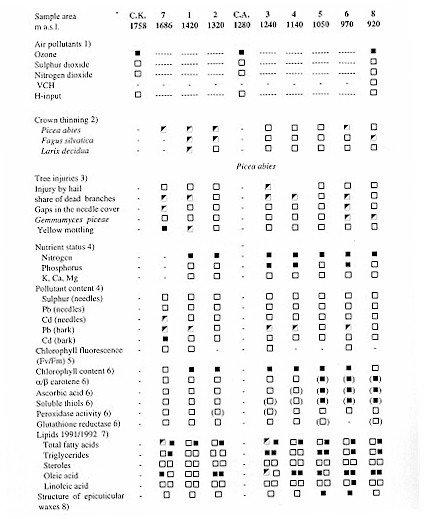
Comparison of the sample areas by a classification of stress parameters: Table 7.
Table 7. Rough classification of the sample areas by means of selected parameters (mean values), basing on the present knowledge
Vertical course of stress (Altitude profile Zillertal, Altitude profiles Achenkirch)
The above described results of the vertical courses of various parameters of the integrated monitoring as well as the bioindication parameters and indicator values are compiled in Table 8 in a simplified way including also the results of the "Altitude Profile Zillertal" (Herman & Stefan 1992). It can be derived from that overall stress increases (mainly oxidant stress) with increasing altitude.
Table 8.Simplified course of the measured parameters depending on altitude and altitude of maximum and minimum values (from Herman & Stefan 1992; this paper)
Acknowledgements
The authors would like to thank M. Bergsmann for the translation work.
References
Arndt U., Nobel W. & Schweizer B. 1987. Bioindikatoren - Möglichkeiten, Grenzen und neue Erkenntnisse.- Verlag E. Ulmer, Stuttgart.
Austrian Academy of Sciences 1989. Luftqualitätskriterien Ozon.- Federal Ministry of Environmental, Youth and Family Affairs (ed.).
Berger T.W., Katzensteiner K., Glatzel G. & Sieghardt M. 1993. Eintrag und Umsatz langzeitwirksamer Luftschadstoffe in Waldökosystemen der Nordtiroler Kalkalpen.- University of Agriculture, Interim Report.
Bermadinger-Stabentheiner E. 1994. Stress-physiological investigations on spruce trees (Picea abies [L.] Karst.) from the "Achenkirch Altitude Profiles.- Phyton, this issue.
Bolhar-Nordenkampf H. (ed.) 1989. Streßphysiologische Ökosystemforschung Höhenprofil Zillertal.- Phyton 29 (3).
Bolhar-Nordenkampf & Lechner 1989. Synopse streßbedingter Modifikationen der Anatomie und Physiologie von Nadeln als Frühdiagnose einer Disposition zur Schadensentwicklung bei Fichte.- Phyton 29 (3), 255-301.
Bolhar-Nordenkampf H. & Götzl M. 1992. Chlorophyllfluoreszenz als Indikator der mit der Höhenlage zunehmenden Streßbelastung von Fichtennadeln.- FBVA Reports (Federal Forest Research Centre, ed.), vol. 67, 119-132.
Brandtner B., Puxbaum H., Biebl P., Gläser O. & Mahringer W. 1989. Luftschadstoffuntersuchungen entlang der Tauernautobahn.- Technical University of Vienna, Institute for Analytical Chemistry, Report 5/89.
Bundesministerium für Land- und Forstwirtschaft 1994. Erhebung des Waldzustandes im Raum Arnoldstein als Basis für die Beurteilung der Veränderungen nach Reduzierung der SO2-Immissionen. Endbericht G. Halbwachs, Projektskordination).
Cech T. 1994. Differentialdiagnostische Untersuchungen an Fichtenästen.- FBVA Reports (Federal Forest Research Centre, ed.), in press.
Federal Environmental Agency 1992. Pestizide im Niederschlag - eine Zwischenbilanz.- UBA-Info, November 1992.
Federal Forest Research Centre 1992a. Ökosystemare Studien in einem inneralpinen Tal. Ergebnisse aus dem Projekt ”Höhenprofil Zillertal”.- FBVA Reports, vol. 67.
Federal Forest Research Centre 1992b. Ökosystemare Studien im Kalkalpin. Erste Ergebnisse aus dem Projekt ”Höhenprofile Achenkirch”.- FBVA Reports, vol. 70.
Federal Forest Research Centre 1992c. Papers and Documents Provided for the Achenkich Meeting November 19, 1992.
Frank H., Vital J. & Frank W. 1989. Oxidation of airborne C2-chlorocarbons to trichloroacetic acid.- Fesen. Z. Anal. Chem. 333, 713.
Gath B., Jaeschke W., Kubiak R., Ricker I., Schmider F. & Zietz E. 1993. Eintrag von Pflanzenschutzmitteln durch nasse Deposition auf dem Kleinen Feldberg/Taunus. Source: Stoffeinträge aus der Atmosphäre und Waldbodenbelastung in den Ländern von ARGE ALP und ALPEN ADRIA.- GSF Report 39/93, 460-464.
Guderian R., Klumpp G. & Klumpp A. 1990. Reaktionen von Baumarten auf Luftschadstoffe unter kontrollierten Bedingungen.- In: Ulrich B. (ed.), Int. Congr. on Forest Decline Research. State of knowledge and perspectives. Lectures Volume, Friedrichshafen, pp. 445-478.
Gulder H.J. & Kölbel M. 1993. Waldbodeninventur in Bayern.- Forstl.Forschungsberichte München, 192.
Havranek W.M. & Wieser G. 1993. Zur Ozontoleranz der europäischen Lärche (Larix decidua Mill.).- Forstw. CBl. 112, 56-64.
Herman F. 1992a. Ökosystemare Studien im Kalkalpin.- FBVA Reports (Federal Forest Research Centre, ed.), vol. 70, 5-12.
Herman F. 1992a. Schwermetallgehalte von Fichtenborken als Indikator für anthropogene Luftverunreinigungen.- VDI-Berichte 901 (Bioindikation. Ein wirksames Instrument der Umweltkontrolle) , 375-389. VDI Verlag Düsseldorf.
Herman F. & Stefan K. 1992. Zusammenschau: Ökosystemare Studien im Zillertal.- FBVA Reports (Federal Forest Research Centre, ed.), vol. 67, 139-147.
Herman F. 1993. Ökosystemare Studien im Kalkalpin. Stoffeinträge aus der Atmosphäre und Waldbodenbelastung in den Ländern von ARGE ALP und ALPEN ADRIA.- GSF Report 39/93, 406-413.
Herman F., Leitner J. & Smidt S. 1993. ”Höhenprofile Achenkirch” Measuring Report 1992.- Federal Forest Research Centre, Report G3-1/1993.
Herman F. 1994. Schwermetallgehalte von Fichtennadeln als Kriterium zur Beschreibung der Umweltsituation.- Doctoral Thesis, University of Agriculture.
Hofmann P. 1992. Immissionsökologisch orientierte Flechtenkartierung im Raum Achenkirch.- FBVA Reports (Federal Forest Research Centre, ed.), vol. 70, 91-101.
Kaiser A. 1994a. Analyse der vertikalen Temperatur und Windstruktur und ihr Einfluß auf die Immissionskonzentration.- FBVA Reports (Federal Forest Research Centre, ed.), vol. 77
Kaiser A. 1994.b. Analyse der meteorologischen Verhältnisse im Raum Achenkich. Zentralanstalt für Meteorologie und Geodynamik, Interim Report.
Knabe W. 1983. Immissionsökologische Waldzustandserfassung.- Mitt. LÖLF, Sonderheft "Immissionsbelastungen von Waldökosystemen", 43-57.
Knabe W. 1984. Merkblatt zur Entnahme von Blatt- und Nadelproben für chemische Analysen.- Allg. Forstzeitschr., 847-848.
Kovar A. & Puxbaum H. 1992. Nasse Depositionen im Ostalpenraum.- Technical University of Vienna, Institute for Analytical Chemistry, Report 14/92.
Krause G.H.M. & Prinz B. 1989. Experimentelle Untersuchungen der LIS zur Aufklärung möglicher Ursachen der neuartigen Waldschäden.- LIS Report 80, Landesanstalt für Immissionsschutz Nordrhein-Westfalen, Essen.
Krehan H. & Tomiczek C. 1992. Forstliche Beschreibung der Probebäume an den Höhenprofilen Achenkirch.- FBVA Reports (Federal Forest Research Centre, ed.), vol. 70, 19-24.
Krugmann G. & Winkler P. 1989. Abschätzung der feuchten Deposition durch Nebel aufgrund gemessener chemischer und meteorologischer Parameter.- German Meteorological Service.
Krupa S.V. & Arndt U. 1990. The Hohenheim long-term experiment.- Environmental Pollut. Vol. 68, 481. Elsevier Applied Science.
Larcher W. 1985. Winter stress in high mountains in Turner H. & Tranquillini W. (eds.): Establishment and tending of subalpine forest: Research and management. Eidgen. Anst. Forstl. Versuchsw. Report, 270, 11-19.
Lin N.H. & Saxena V.K. 1991. Interannual variability in acidic deposition on the Mt.Mitchell Area Forest.- Atmos. Environment 25A, 2, 517-524.
Lütz C. & Dodell B. 1994. Photosynthetic performance of spruce trees from selected research areas of the mountain forests near Achenkirch.- Phyton, this issue.
Margl H. 1994. Klimadaten aus dem Raum Achenkirch. FBVA-Reports (Federal Forest Research Centre, ed.), vol. 78, 17-25.
Miller E.K. et al. 1993. Atmospheric deposition to forests along an elevational gradient at Whiteface Mountain, NY, USA.- Atmos. Environment 27A, 14, 2121-2136.
Ministry of Environment of North Rhine-Westphalia (ed.) 1993. Forschungsschwerpunkt Luftverunreinigungen und Waldschäden. Ziele, Ergebnisse, Schlußfolgerungen.
Mutsch F. 1992. Österreichische Waldboden-Zustandsinventur. Ergebnisse Waldbodenbericht. Teil VI: Schwermetalle.- Mitt. Forstl.BVA 168/II, 145-188.
Mutsch F. & Smidt S. 1994. Durch Protoneneintrag gefährdete Waldgebiete in Österreich.- Centralbl. f. d. ges. Forstwes. 111 (1), 57-66.
Office of the Provincial Government of the Tyrol 1989. Zustand der Tiroler Wälder - Report to the Provincial Diet of the Tyrol, 135pp.
Office of the Provincial Government of the Tyrol 1991a. Zustand der Tiroler Wälder - Report to the Provincial Diet of the Tyrol.
Office of the Provincial Government of the Tyrol 1991b. Auswirkungen des Straßenverkehrs auf die Umwelt.
Office of the Provincial Government of the Tyrol 1994. Zustand der Tiroler Wälder - Report to the Provincial Diet of the Tyrol.
Plümacher J. & Renner I., 1991. Biomonitoring von Immissionsbelastungen mit der Bestimmung von leichtflüchtigen Chlorkohlenwasserstoffen und Trichloressigsäure in Koniferennadeln.- VDI Reports 901, 217-233.
Plümacher J., Wolf A. & Schröder P. 1994. Accumulation of C1/C2-chlorocarbons and trichloroacetic acid and a possible correlation with glutathione-S-transferass in conifer needles.- Phyton, this issue.
Puchinger L. & Stachelberger H. 1994. Bestimmung der Nadellipide zur Bewertung der Streßsituation von Fichtenbeständen in den "Höhenprofilen Achenkirch".- FBVA-Reports (Federal Forest Research Centre, ed.), vol. 78, 83-90.
Puchinger L. & Stachelberger H. 1994. Determination of lipids in spruce needles as stress indicators in the "Achenkirch Altitude Profiles".- Phyton, this issue.
Reiter R. 1988. Meßreihen atmosphärischer Spurenstoffe an alpinen Stationen Südbayerns zwischen 0,7 und 3km Höhe.- Wetter und Leben 40, 1-30.
Scharf J., Wiesiollek R. & Bächmann K. 1992. Pesticides in the atmosphere.- Fresenius J. Z. Anal. Chem. 342, 813-816.
Schröder P. 1990. Deposition und Entgiftung anthropogen emittierter halogenierter Kohlenwasserstoffe und Pestizide in Fichten.- Fraunhofer-Gesellschaft, Tätigkeitsbericht 1990, 73-78.
Schröder P., Pflugmacher S. & Rennenberg H. 1992. Biomarker für organische Schadstoffe in Fichten (Picea abies L.): Dynamik des Entgiftungssystems Glutathion-S-Transferase.- Angew. Bot. 66, 174-179.
Schröder P., Berkau C., Nathaus F.J., Weiss A. & Wolf A. 1994. Untersuchungen zur Aufnahme anthropogen emittierter Chlorkohlenwasserstoffe und deren Entgiftung durch Fichten vom Schwerpunktstandort Kalkalpen.- Fraunhofer-Institut für Atmosphärische Umweltforschung, Bd. 24/94.
Simons S. 1993. Biochemische Effekte und Symptomentwicklungen bei Buchen (Fagus silvatica) und Nadelgehölzen unter realen und proportional erhöhten Ozonkonzentrationen.- Doctoral thesis, Ludwig-Maximilians Universität, Munich.
Smidt S., Gabler K. & Halbwachs G. 1991. Beurteilung österreichischer Ozonmeßdaten in Hinblick auf wirkungsbezogene Grenzwerte.- Staub Reinh. Luft 51, 43-49.
Smidt S. & Mutsch F. 1993. Messung nasser Freilanddepositionen an alpinen Höhenprofilen. Proceedings ”Stoffeinträge aus der Atmosphäre und Waldbodenbelastung in den Ländern von ARGE ALP und ALPEN ADRIA.- GSF Report 39/93, 21-29.
Smidt S. & Gabler J. 1995. Luftschadstoffmessungen im Raum Achenkirch - Ergebnisse 1992.- Phyton (this issue).
Smidt S. 1995. Measurements of field deposition in the area of Achenkirch.- Phyton (this issue).
Stefan K. 1994. Die Nährelementversorgung der Fichte (Picea abies) nach den Ergebnissen des Österreichischen Bioindikatornetzes von 1983-1990.- Proceedings ECO-INFORMA ’94, vol. 5, 253-264.
Tranquillini W. 1964. The physiology of plants at high altitudes.- Ann. Review of Plant Physiology 15, 345-362.
Tranquillini W. 1979. Physiological ecology of the Alpine timberline.- Ecological Studies 31. Springer Verlag Berlin, Heidelberg, New York.
UN-ECE 1988. Critical Loads Workshop. 19.24.3.1988.- Skokloster (Sweden).
UN-ECE 1994. Critical Levels for ozone - a UN-ECE Workshop. Führer J. & Achermann B. (eds.). Swiss Federal Research Station for Agricultural Chemistry and Environmental Hygiene, Switzerland. Schriftenreihe der FAC Liebefeld. no. 17.
Verein Deutscher Ingenieure 1983. Säurehaltige Niederschläge-Entstehung und Wirkung auf terrestrische Ökosysteme.- VDI Kommission Reinhaltung der Luft.
Verein Deutscher Ingenieure 1989. VDI Guideline 2310, Part 6: Maximale Immissionskonzentration für Ozon.
Wieser G. & Havranek W.H. 1993. Ozone uptake in the sun and shade crown of spruce: quantifying the physiological effects of ozone exposure.- Trees 7, 227-232.
Winkler P. & Pahl S. 1993. Spurenstoffeintrag in Nadelwälder durch Nebelinterzeption in Schwarzwaldhochlagen.- Research Report KfK-PEF.
Zechmeister H. 1994. Biomonitoring der Schwermetalldeposition mittels Moosen in Österreich.- Monographien, vol. 42, Federal Environmental Agency.
Phyton (Horn, Austria) 34 (3), 169-192.
| FeiH/FieSy, 10/3/98 |  |
   |
|